
Liberia: Promise of Power and Roads Collides With Warnings of Hidden Debt as Bea Mountain Deal Heads for Signing, Legislative Debate
Monrovia- Every dry season, Monrovia goes through the same routine. River levels on the St. Paul fall, the turbines at Mount Coffee slow down, and the lights flicker…

Published by FrontPage Africa
Original author: Rodney Sieh
Content ownership remains with the original publisher.
Monrovia- Every dry season, Monrovia goes through the same routine. River levels on the St. Paul fall, the turbines at Mount Coffee slow down, and the lights flicker and go out across the capital. Generators start up in businesses, hospitals and homes. Liberians have lived with this for so long that many now treat it as normal.
By Rodney D Sieh
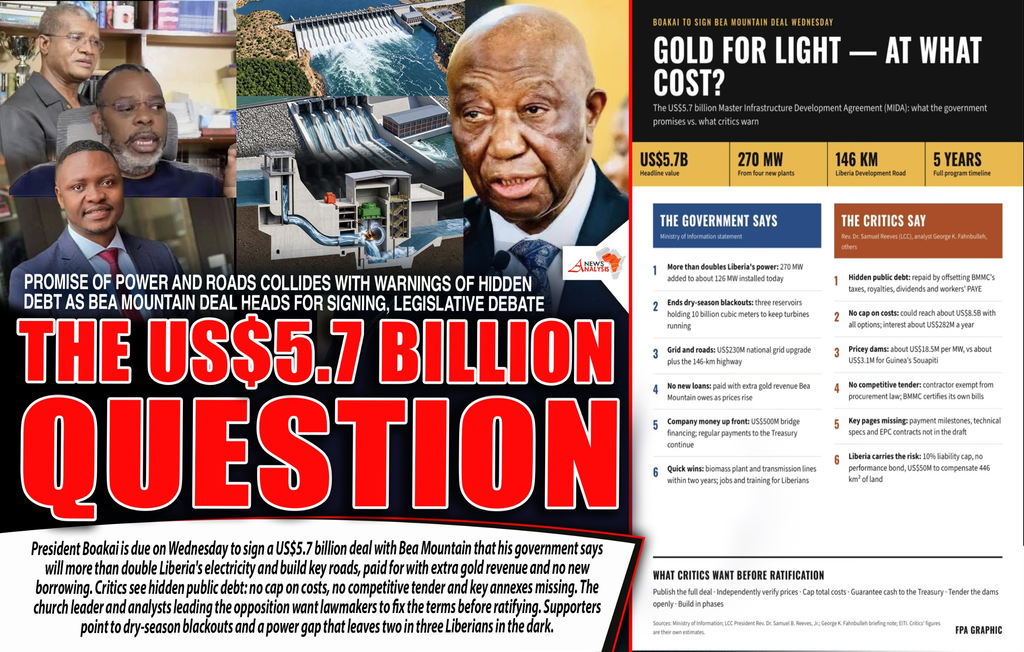
On Wednesday, President Joseph Nyuma Boakai is due to sign a deal his government says will change that. The Master Infrastructure Development Agreement (MIDA) with Bea Mountain Mining Corporation (BMMC) is valued at about US$5.7 billion. The President received the agreement from the Inter-Ministerial Concession Committee. After he signs it, the Legislature must ratify it.
Within days of the announcement, the deal had become one of the most hotly debated documents in the country. Churchmen, analysts, opposition figures and columnists have warned that Liberia may be signing away its future gold income on terms that heavily favor the company. The government calls it a once-in-a-generation opportunity.
Both sides could be right. This is what the deal promises, what its critics fear, and what lawmakers need to settle before they vote.
THE PROMISE
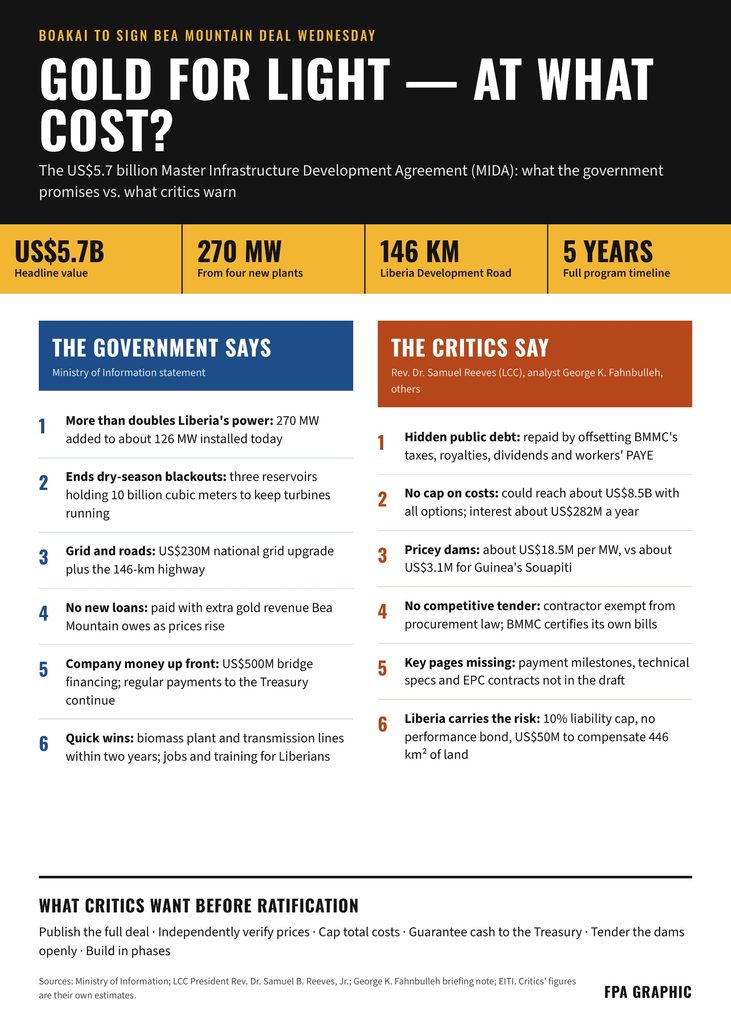
The power shortage the deal targets is real. Liberia’s installed capacity was about 126 MW in 2024, while officials put national demand at roughly 400 MW. MIDA’s 270 MW would more than double current capacity. Only about a third of Liberians had electricity in 2023, according to World Bank data, and rural access was below 10 percent.
Under the plan, the 270 MW would come from four plants: a 100 MW hydropower plant on the Via River, a 100 MW plant at SP3 on the St. Paul River, a 10 MW plant at SP4 further along the St. Paul, and a 60 MW biomass plant near the Via dam. The reservoirs are central to the design. Three of them, with combined storage of 10 billion cubic meters, would hold high-flow water and release it through the turbines when river flows fall. That is the government’s answer to the dry-season blackouts.
The package also includes US$230 million to upgrade substations, transformers and transmission lines on the national grid, along with the 146 km Liberia Development Road linking the power plants to key facilities.
The government’s pitch rests on how the deal will be paid for. Instead of new loans, it plans to ring-fence additional revenue payable by BMMC, made possible by high gold prices. BMMC is also pledging US$500 million in bridge financing and will keep making its regular payments to the Consolidated Account. Officials call this “innovative financing” that would reduce Liberia’s debt burden. The government statement goes further, describing the deal as “the single most transformative catalyst for the nation’s development in decades.”
The schedule is ambitious. The full program is meant to take five years, with the biomass plant and transmission lines targeted within two years.
THE PRICE
Critics are not arguing about whether Liberia needs power. They are asking what the country will pay for it, and who will decide.
The most detailed objection has come from Rev. Dr. Samuel B. Reeves, Jr., President of the Liberia Council of Churches. He is urging the Legislature not to ratify the current version of the agreement. He says the copy he reviewed is missing key documents: the Annex C payment milestones, the Annex E technical specifications and the EPC contracts. Without them, he argues, no one can independently assess pricing and delivery.
His figures suggest the bill may be larger than the headline number. The eight primary projects have a base cost of US$4.4513 billion, rising to about US$5.6813 billion with additional roads and grid work. A further project ceiling of about US$2.23 billion could apply, and he says the draft sets no all-in ceiling.
The repayment mechanism worries him most. BMMC could offset its corporate income tax, royalties, withholding taxes, the dividends on Liberia’s 5% stake and its employees’ PAY against project costs. He warns that the Treasury might receive no guaranteed cash.
Independent analyst George K. Fahnbulleh reaches a similar conclusion in a briefing note to officials. He calls the arrangement “undisclosed public debt” repaid outside the Public Financial Management Act and the national debt sustainability analysis. By his estimate, the three dams would cost US$3.88 billion for 210 MW, about US$18.5 million per megawatt. He compares that with roughly US$3.1 million per megawatt for Guinea’s Souapiti dam. He projects interest of about US$282 million a year once the works are built, against total BMMC payments to government of about US$33.5 million in 2023. If the offsets cannot keep up with the interest, he warns, the balance could grow indefinitely and pass to future governments.
Reeves singles out the smallest dam. SP-4 is priced at US$634.44 million for 10 MW, or about US$63.4 million per megawatt. He concedes that reservoir and water-transfer works mean this alone does not prove overpricing, but says it warrants independent review.
Both men raise concerns about how the contract was awarded. The draft exempts the contractor and EPC contracts from public procurement law, and MAPA is the exclusive initial contractor. The Auditor General can inspect payment certificates but not actual costs. Liability is capped at 10% of the contract price, and there is no performance bond.
Writing in The New Dawn, columnist Seltue Robert Karweaye Sr. puts the central question bluntly. He argues that if the deal is financed from Liberia’s own future gold revenues rather than new foreign capital, it is a commitment of public money, not a generous investment. He also notes that Bea Mountain is a mining company, not an infrastructure developer, and asks whether there was any competitive bidding.
The political reaction has been harsher. Commentator Martin Kollie has urged President Boakai to abandon the deal. Emmanuel C.D. Gonquoi of the Economic Freedom Fighters of Liberia called it “daylight corporate robbery” under the guise of development.
THE TRACK RECORD
Much of the skepticism comes from Bea Mountain’s history in Grand Cape Mount.
Critics point to the gap between what the mine produces and what the state collects. According to the 16th EITI report, BMMC exported about 12,146 kilograms of gold worth over US$653 million in fiscal year 2023. Both Grand Cape Mount senators have demanded renegotiation of the existing mineral agreement. Sen. Dabah Varpilah describes the flat 3% royalty as inadequate and inequitable as gold values climb.
Questions over taxes are also still open. In October, a preliminary review by Sen. Amara Konneh found that Bea Mountain lifted 16.4 million gallons of diesel over nine months without paying levies. The company claims a duty-free exemption, and final liability is unconfirmed. A House joint committee is reviewing three years of its corporate income tax payments.
Environmental and community grievances add to the pressure. A May 2022 cyanide spill from the tailings facility was linked to fish deaths near Jikandor, Marvoe Creek and the Mafa River. The EPA says corrective measures, including tailings dam reinforcement, have since been implemented. In July 2025, residents of Ngojah Town petitioned the Supreme Court over alleged illegal land seizure and contamination. These remain allegations, not court findings.
That record bears directly on MIDA, because the new deal would flood large areas for reservoirs. Reeves notes that Annex A covers at least 446.42 square kilometers, while only US$50 million is set aside for compensation.
The company also has supporters on the ground. Residents of the Matamo Corridor in Grand Cape Mount recently commended BMMC for its development initiatives. Their statement cited education, youth empowerment, healthcare and jobs.
WHAT NOBODY HAS ANSWERED
Several basic questions remain unanswered. The government statement does not say how much extra revenue is involved or how it differs from the company’s existing obligations. Nor does it say how the new plants would fit with the planned 150 MW SP2 dam, which the World Bank Group pledged US$300 million toward in 2023. The price Liberians will pay for the electricity has not been disclosed, and lawmakers will want to know what happens to the financing if gold prices fall.
BMMC has not publicly answered the specific charges raised by Reeves, Fahnbulleh or others.
A MIDDLE ROAD
Almost none of the deal’s critics are saying Liberia should walk away from building power plants and roads. What they reject is the agreement in its current form.
Their proposals have a lot in common. Reeves wants five conditions met before ratification: publish the full deal and independently verify its prices; cap total exposure and guarantee minimum cash payments to the Treasury; tie payments to certified, usable infrastructure; give the Auditor General full access to cost records; and make community and jobs commitments binding.
Fahnbulleh suggests splitting the program. A small, fully specified first phase covering biomass, transmission and a road would go ahead on corrected terms. Each dam would need its own feasibility study, an open tender with development-bank financing, and a separate ratification vote. In his framing, the MIDA would become “the benchmark to beat” rather than the only option.
Splitting the program could keep the projects that would deliver early benefits, such as the biomass plant and the transmission lines the government already wants within two years, while giving the far more expensive dams the scrutiny they need.
THE BOTTOM LINE
Timing matters. Fahnbulleh warns that once the agreement is ratified, its terms would be protected by Article 25 of the Constitution and the deal’s stabilization clause, so any problems have to be fixed before then.
Liberia needs the power and the roads. Higher gold prices have given it real bargaining power. The question for lawmakers is whether this agreement makes the most of that moment for Liberians, or ties up decades of the country’s gold income on terms few people have been able to read in full.
Published by FrontPage Africa
Original headline, article body, author, publication date, featured media and tags are displayed with attribution. Content ownership remains with the original publisher.
Read on the publisher's site