
Liberia: From Monrovia to Sinoe – Koon’s Political Move Reignites Debate Over Constituency Hopping
MONROVIA – Romeo Quioh did not mince words. Speaking on a Monrovia radio station on Monday, the lawmaker who represents District #1 of Sinoe County, a coastal stretch…

Published by FrontPage Africa
Original author: Rodney Sieh
Content ownership remains with the original publisher.
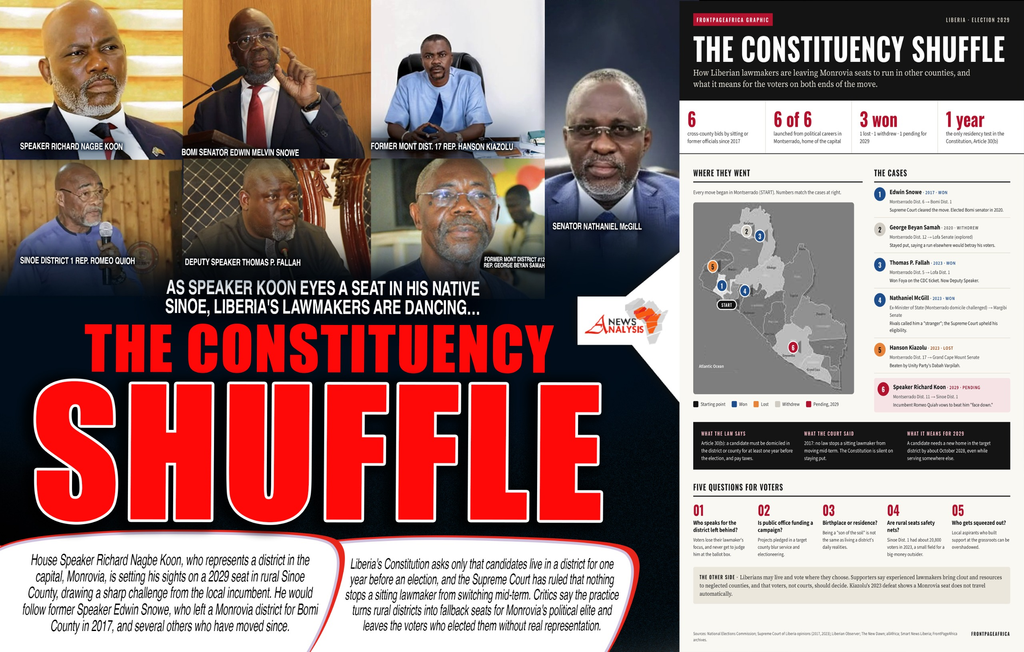
MONROVIA – Romeo Quioh did not mince words.
Speaking on a Monrovia radio station on Monday, the lawmaker who represents District #1 of Sinoe County, a coastal stretch of Liberia’s rural southeast, said he would beat the most powerful man in the House of Representatives “face down.”
By Rodney D. Sieh
“Speaker Koon will be a former lawmaker after 2029,” Quioh declared, describing himself as a true son of the county.
The target of his warning, House Speaker Richard Nagbe Koon, does not currently represent Sinoe at all. Since 2017, he has represented Electoral District #11 in Montserrado, the crowded county that is home to the capital, Monrovia. He was reelected there in 2023 and elevated to the speakership the following year. But Koon was born in Sinoe, and he has signaled that when Liberians next go to the polls in 2029, he wants to represent his home county instead.
It is a move that would have been almost unthinkable a generation ago. Today, it is becoming something of a pattern.
The Man Who Wrote the Playbook
The road Koon appears ready to travel was first paved by Edwin Melvin Snowe Jr., himself a former Speaker.
Snowe was first elected in Montserrado in 2005 and later represented the capital’s District #6. Ahead of the 2017 elections, while still sitting in the Legislature for that Monrovia district, he registered as a voter in Senjeh, in Bomi County, about an hour’s drive north-west of the capital, and announced he would run for Bomi’s District #1 seat. At the time, it was described as the first move of its kind in Liberia’s modern democratic history.
Bomi’s political establishment fought back. The county’s senator, Sando Johnson, and the district’s sitting representative, Samuel Gayah Karmo, argued that a lawmaker serving Montserrado could not simply change his home mid-term to chase a seat elsewhere. An elections hearing officer agreed and blocked Snowe, before the National Elections Commission’s board reversed that decision.
The fight ended at the Supreme Court. In September 2017, the justices ruled that no law forbids a sitting representative from changing his domicile to another county while still serving the one that elected him. They went further, acknowledging that neither the Constitution nor the election law says whether a lawmaker must keep living in the district he represents, and declining to fill that silence themselves.
Snowe went on to win the Bomi seat. Three years later, in a December 2020 special election, he won a seat in the Senate representing the whole county. For ambitious politicians watching from Monrovia, the lesson was plain: it could be done.
Others Follow, With Mixed Results
In the years since, others have tested the same path.
Thomas P. Fallah, a long-serving representative for Montserrado’s District #5, said an emotional goodbye to his Monrovia constituents in August 2023 and headed for Lofa County in the far north, where he contested and won District #1. He is now Deputy Speaker of the House.
That same year, Nathaniel McGill, a former Minister of State for Presidential Affairs and one of the most powerful figures in the previous government, sought a Senate seat in Margibi County, next door to the capital. Citizens petitioned the elections commission, accusing him of falsely swearing that he lived in Margibi while his home was in Monrovia, and rival candidates branded him a “stranger” to the county. The Supreme Court upheld his eligibility, and Margibi voters elected him.
Not every attempt has succeeded. Hanson Kiazolu, then representing Montserrado’s District #17, ran for the Senate in Grand Cape Mount County in 2023, arguing that his home county had been held back by poor leadership. He lost to Dabah Varpilah of the Unity Party, while some of his own Monrovia constituents openly complained that he was walking away from them.
And at least one lawmaker thought better of it. George Beyan Samah, of Montserrado’s District #12, publicly explored a Senate run in Lofa in 2020 before stepping back, saying that spending his resources campaigning elsewhere would betray the people who had trusted him with their votes.
The common thread is hard to miss. Most of these journeys run in the same direction, out of the capital and into the rural counties that many Monrovia politicians call home, carrying name recognition, money and influence built up over years in the city.
A Thin Legal Line
Liberia’s rules on this are remarkably light.
Article 30(b) of the 1986 Constitution requires anyone seeking a seat in the Legislature to have been domiciled in the county or district they want to represent for at least one year before the election, and to be a taxpayer. That is it. The Constitution says nothing about whether a lawmaker must keep living in the district through his term, nothing about whether he may campaign or channel resources elsewhere while still drawing a salary to represent his current voters, and the courts have made clear they will not add such conditions on their own.
In practice, a candidate aiming for 2029 needs only to establish a home in his chosen district by around October 2028. He can remain the sitting representative of somewhere else the entire time.
Some citizens think the bar is too low. During consultations on electoral reform, residents of Grand Cape Mount called for the residency requirement to be doubled to two years.
What It Means for Voters
For the people at the heart of all this, the voters, the trend raises uncomfortable questions.
The first concerns the district left behind. The voters of Montserrado’s District #11 elected Koon in 2023 to a six-year term that runs until 2029. If his attention, energy and political capital shift to Sinoe in the final stretch, those voters are left with a representative in name only. And they lose the one tool every democracy gives citizens to judge their lawmaker: they will never get to vote him in or out again, because he will not be on their ballot.
The second concerns the blurred line between office and campaign. In July, Koon traveled to Greenville, Sinoe’s capital, and pledged to mobilize legislative support to restore the nursing program at Sinoe Community College, adding that the Legislature intends to increase its support for the county.
Few would argue that Sinoe does not need the help. But when the Speaker of the House makes promises in a county where he hopes to run, voters are entitled to wonder whether they are hearing a commitment from the Legislature, or the opening pitch of a campaign.
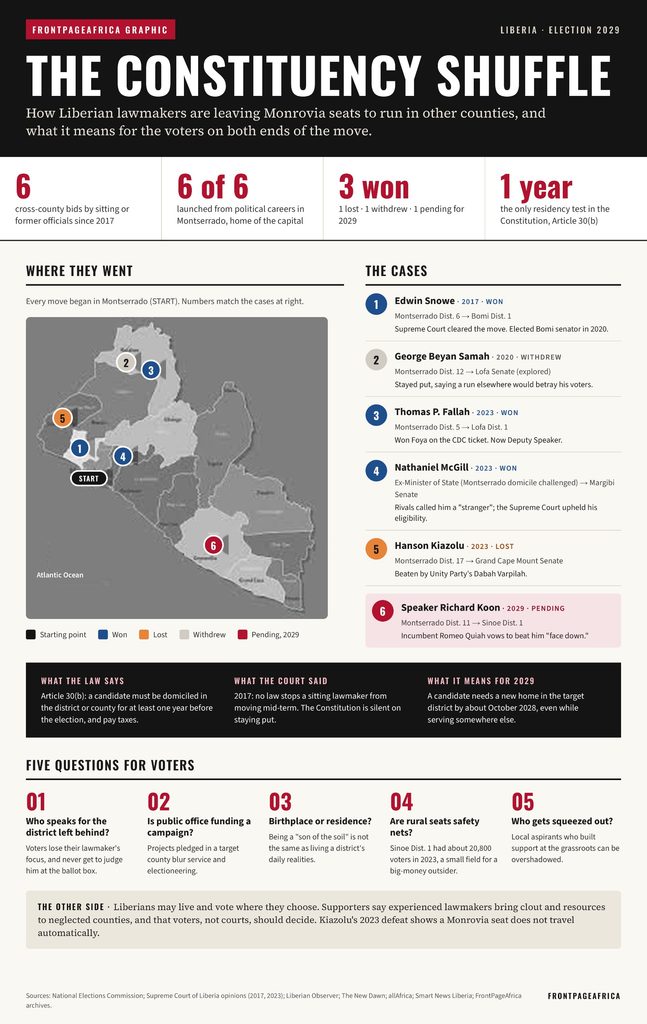
The third is about what “home” really means. Almost every lawmaker who has switched counties has framed the move as a homecoming. Yet representation is meant to be about the people who live in a place, its roads, its clinics, its schools, rather than where a candidate happened to be born. A politician who has spent two decades building a career in Monrovia may be a son of the soil on paper, while the local representative is the one who has lived with the district’s daily struggles.
The fourth is about power and money. Montserrado’s districts are crowded and fiercely contested. Rural districts are far smaller: Sinoe District #1 had roughly 20,800 registered voters in 2023. A well-funded outsider with a national profile can make a big splash there. Critics worry that rural counties are quietly becoming safety nets for Monrovia’s political elite, places to retreat to when the city turns against them or when a smoother path to power beckons.
Some political observers have argued that these cross-county ambitions are driven largely by deep pockets and self-promotion.
Finally, there is the question of who gets squeezed out. When a Speaker or a former minister parachutes into a county race, local aspirants who have spent years building support at the grassroots can find themselves overshadowed.
Quiah’s fiery response suggests how threatened sitting rural lawmakers feel. If the trend continues, the next generation of county-based leaders may find the doors to the Capitol closed to them.
The Case for Freedom to Move
There is, of course, another side to the argument.
Liberians are free to live and vote where they choose. When Snowe’s candidacy was challenged in 2017, his lawyer, former Attorney General Benedict Sannoh, argued that no law restricts a citizen from voting wherever he wants.
Snowe’s bid also came with the backing of at least 27 chiefs and elders in Bomi. Supporters of these moves argue that experienced lawmakers bring clout, connections and resources to counties that have long been neglected, and that the decision on whether an outsider deserves a chance should rest with voters, not with courts or rival politicians.
The record also suggests that voters are not easily swept off their feet. Kiazolu’s defeat in Grand Cape Mount is a reminder that a seat in Monrovia does not automatically travel with its holder. A familiar name may open doors, but it does not guarantee victory.
The Road to 2029
With the Speaker of the House now part of the story, a debate that once lived on the margins of Liberian politics has moved to the center, and it deserves an open public discussion before the 2029 campaign gets fully under way.
There are practical questions for lawmakers and the elections commission to consider. Should a sitting lawmaker who intends to run elsewhere be required to declare it early, or even step down? Should the residency requirement be extended? Should there be clearer rules separating a lawmaker’s official pledges and spending from his campaign ambitions in another county?
There is a certain irony in the fact that the person best placed to put those questions before the House is Speaker Koon himself.
For voters in Sinoe’s District #1, the choice in 2029 may come down to a local incumbent who says he never left and a powerful native son who says he is coming home.
For voters in Montserrado’s District #11, the more urgent question is simpler: who is speaking for them right now?
Published by FrontPage Africa
Original headline, article body, author, publication date, featured media and tags are displayed with attribution. Content ownership remains with the original publisher.
Read on the publisher's site