
How a $54 Million Deal Nearly Handed Liberia’s Identity Registry to an Austrian Firm Without a Bid
MONROVIA – Rick Scott got to the registration center in Red Light before dawn. He had left his job, paid the $5 fee and joined a line hundreds of…

Published by FrontPage Africa
Original author: Rodney Sieh
Content ownership remains with the original publisher.
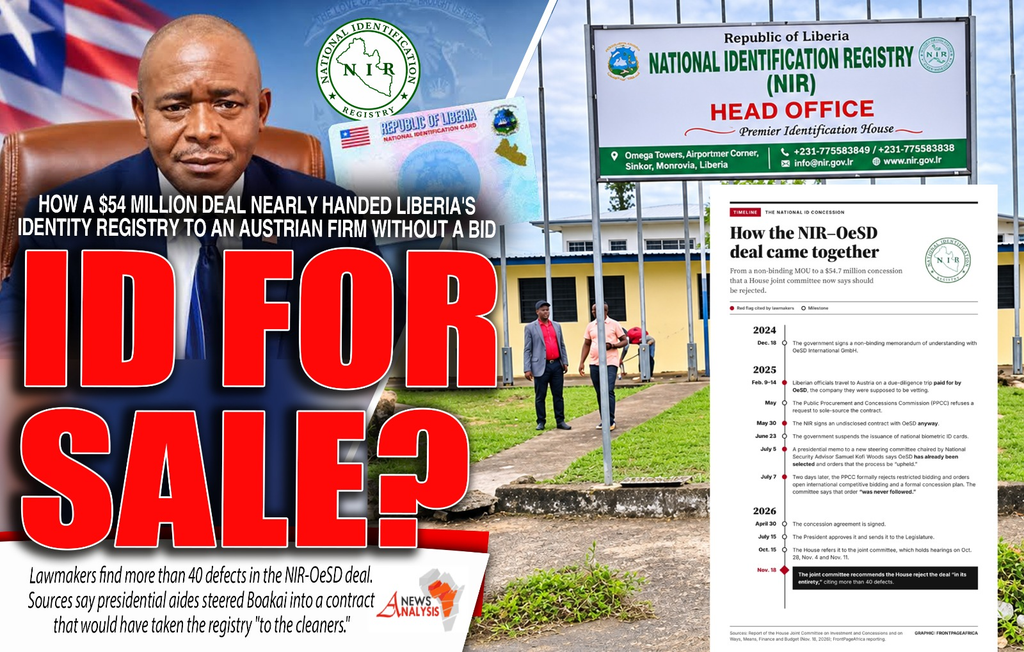
MONROVIA – Rick Scott got to the registration center in Red Light before dawn. He had left his job, paid the $5 fee and joined a line hundreds of people long. By evening, he went home with no ID card. It was his fourth try that week.
By Rodney D. Sieh
“I leave my job in the morning and come to find an identification card because it’s a government mandate,” the 54-year-old businessman told New Narratives earlier this year. “Some of us are not feeling well, but we are forced to come here.”
For Liberians outside Monrovia, it is worse. In many counties there is a single enrollment center. A resident of Foya can pay for transport to enroll, go home, then pay again to come back for the card.
The card is not optional. Under an April 2025 executive order, Liberians need it to bank, buy a SIM card, see a doctor, enroll in school and deal
with immigration. Many have been turned away from those services before they could even get one.
This is the problem the government said OeSD would fix. When President Joseph Nyuma Boakai sent the Legislature a $54.7 million concession to rebuild Liberia’s national identity system, it came with his approval. It also came with an operator already picked. Nobody had bid for the job.
Now a House joint committee has recommended that the deal be thrown out entirely. In a report dated Nov. 18, 2026, the Joint Committee on Investment and Concessions and on Ways, Means, Finance and Budget said it found “over 40 distinct defects” in the agreement between the government and OeSD International GmbH. The Austrian firm’s Vienna-registered contracting entity, the report says, has share capital of just 35,000 euros.
The committee said several of the defects were “statutory violations that occurred prior to execution.” Ratification by the Legislature, it said, could not cure them. Several sources familiar with the deal told FrontPageAfrica the President was badly misled by aides who pushed it.
One source, closed to the process to FPA on condition of anonymity that the deal “was going to take the NIR to the cleaners.” Among the most glaring items: a $19.82 million data center the country does not need, because LIBTELCO already has one.
The committee’s case against the agreement comes down to three things: there was no bidding, Liberians’ biometric data was left unprotected and the registry’s own legal mandate was signed away.
A deal sealed before the rules were followed
Liberia already has a national biometric platform. In April 2017, after an open tender among 19 firms, the government paid Techno Brain $5.9 million to build and maintain it. The National Identification Registry (NIR), the National Social Security and Welfare Corporation (NASSCORP) and the National Elections Commission (NEC) still use it.
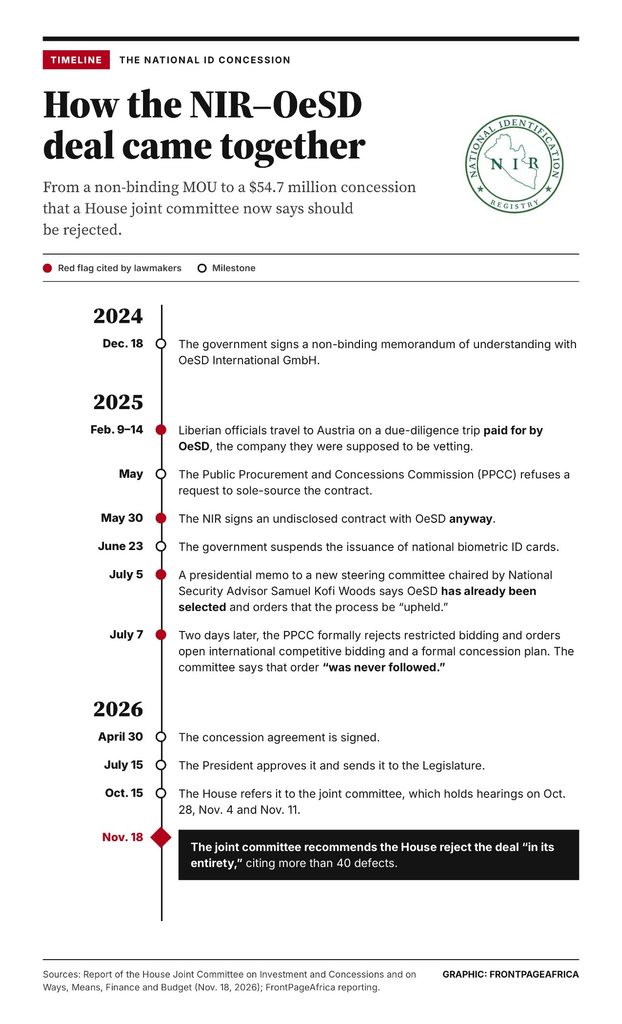
The OeSD deal would have scrapped that system. The committee report and earlier reporting, including leaked procurement documents first published by FrontPageAfrica in August 2025, show how it took shape:
* Dec. 18, 2024: The government signs a non-binding memorandum of understanding with OeSD International GmbH.
* Feb. 9–14, 2025: Liberian officials travel to Austria on a due-diligence trip paid for by OeSD, the company they were supposed to be vetting.
* May 2025: The Public Procurement and Concessions Commission (PPCC) refuses a request to sole-source the contract.
* May 30, 2025: The NIR signs an undisclosed contract with OeSD anyway.
* June 23, 2025: The government suspends the issuance of national biometric ID cards.
* July 5, 2025: A presidential memo to a new steering committee chaired by National Security Advisor Samuel Kofi Woods says OeSD has already been selected and orders that the process be “upheld.
* July 7, 2025: Two days later, the PPCC formally rejects restricted bidding and orders open international competitive bidding and a formal concession plan. The committee says that order “was never followed.”
* April 30, 2026: The concession agreement is signed.
* July 15, 2026: The President approves it and sends it to the Legislature.
* Oct. 15, 2026: The House refers it to the joint committee, which holds hearings on Oct. 28, Nov. 4 and Nov. 11.
The July 2025 memo treated as settled a choice the procurement regulator was about to reject. Woods told The Liberian Investigator at the time that he had not advised the President on the ID contract.
NIR Executive Director Andrew Peters has defended the deal. In September, he told FrontPageAfrica that OeSD would finance about $54.7 million under a build-operate-transfer arrangement to ease the burden on a cash-strapped government. He said Liberian identity data would remain “a national asset under the authority and control of the Republic of Liberia.”
The committee’s reading of the contract is very different.
‘Shall be void’: no bidding, no certificate
The committee’s first and heaviest finding is that the deal was never competed. In its words, the agreement is “legally void.” Under Regulation 57(4) of the PPCC’s amended 2026 regulations, any concession procured without a Certificate of Concession “shall be void.” The committee said the OeSD agreement cites none.
The Executive also went around the PPCC’s July 2025 order for open international bidding. Instead, the deal was handled as an unsolicited proposal. Lawmakers said that route was closed on two counts:
* Regulation 69(9) bars unsolicited proposals when the government makes substantial financial contributions or when the service is contestable.
* Regulation 69(18) requires competitive bidding whenever rival proposals arrive before PPCC approval.
There were rival proposals. MWETANA and Dynamic Global Technologies came forward in September 2025, Lake Piso Solutions on Sept. 29, 2025, and MRT on April 3, 2026. Each submitted an expression of interest, an objection to sole-sourcing or an alternative proposal before the contract was signed.
The committee also found that no summary of the deal’s main terms was published two weeks before signing. Required stakeholder forums in the 15 county seats were never held.
Liberian tech firms: ‘Bad for Liberia’
Liberia’s own technology sector told lawmakers the same thing. Members of the Liberia Information Technology Consortium (LITCON) testified before the joint committee that the concession duplicated systems Liberia already has and was bad for the country.
Top of their list was the data center. The contract charges $19.82 million for a “Renewable License” data center. Yet the state-owned Liberia Telecommunications Corporation (LIBTELCO) already runs a Tier III facility where the system could be co-located, and the government is already obliged to provide Tier IV capacity. In other words, Liberia would pay nearly $20 million for something it already owns.
The committee reached the same conclusion. It also found that the deal would abandon the Techno Brain platform the NIR, NASSCORP and the NEC still use.
Local firms have been sounding the alarm for more than a year. In August 2025, eight Liberian-owned ICT companies wrote to National Security Advisor Woods.
They warned that the NIR was preparing to sole-source a foreign firm and that citizens’ biometric data could end up under foreign control, according to a report of the letter. Among the signers were MWETANA and DGT, two of the firms the committee says were later passed over. The companies noted that Liberia’s biometric ID system, launched in 2012, was built by Liberian experts. They asked that identity-document contracts be at least 75 percent Liberian-owned.
This week, PSI Liberia and its sister company, M Tosh Prints Media, demonstrated biometric equipment at the Capitol and questioned why qualified local firms were never given “an opportunity to compete.” Their representative, Varney Fahnbulleh, showed about $2 million worth of equipment and services, including 150 biometric enrollment kits. By
comparison, the concessionaire committed to 146 kits in its second year. He also said PPCC Executive Director Bodger Scott Johnson had told lawmakers that the President’s Jan. 30, 2026 letter did not ask for single-sourcing.
Who holds the keys to Liberians’ identities?
Every Liberian who enrolls hands over fingerprints and a photograph of their face. Unlike a password, those can never be changed. If they leak, they stay leaked for life. The NIR has said repeatedly that Liberians’ data would stay under Liberian control. The committee found nothing in the contract to guarantee it.
The agreement does not require that primary or backup data be hosted inside Liberia. It does not require hardware security modules, the devices that protect encryption keys. And it does not require the government to hold the root encryption keys to its own citizens’ biometric records.
Lawmakers said the contract allowed data to be transferred before the deal took effect. That breaks the 1,000-record limit on off-site data in Section 23(b) of the Data Protection Act. It also breaks electoral data laws, because the agencies whose data was involved had not consented.
The committee flagged three other risks:
* Base64 is not encryption. Biometric templates would be sent using Base64 encoding. That is a format for moving data, not a lock. Anyone who intercepts it can read it.
* ID by referral. Annex 2, Section 7.1 lets people enroll themselves by phone, including signing up “friends, family and colleagues.” That produces a “partially verified” National Identification Number (NIN) good for opening bank accounts and registering SIM cards before any fingerprints are taken. The committee called it an open door to “systemic identity fraud.”
* Paying twice for storage. The $19.82 million data center, flagged by LITCON, duplicates capacity Liberia already has.
A chapter on data
Protection that appeared in a January 2026 draft was deleted before the agreement was signed, the committee said. So were chapters on anti-corruption and state auditing.
Signing away the registry’s job
The third ground goes to what the NIR exists to do. Article 7.1 of the agreement gives OeSD the exclusive right to assign NINs. It also makes OeSD the only provider of ID cards and identity checks. Under Sections 3.1, 3.2(d) and 7.3 of the NIR Act of 2011, those powers belong to the NIR alone. The committee cited the Supreme Court’s Feb. 12, 2026 ruling in LAC v. LRA that a concession cannot override a statute.
Other clauses reached further:
A toll on daily life
Articles 7.3 and 12.1 would make paid OeSD verification mandatory for nearly every public and private service, from banking and SIM cards to permits and court business. The committee said that goes beyond the NIR Act, and that Executive Order 147 cannot legally expand it.
* Skipping the Legislature. Article 5.3 lets the two parties waive conditions precedent by mutual agreement. One of those conditions is legislative ratification. Lawmakers called the clause “ultra vires and unacceptable.”
* Liberia in a London courtroom. Article 31 sends disputes to UNCITRAL arbitration in London and waives Liberia’s sovereign immunity from enforcement. That would expose Liberian state assets abroad.
* Other agencies’ work. Appendix 4 lists work and residence permits among the concession’s requirements. Those belong to the Ministry of Labour and the Liberia Immigration Service.
* Few jobs for Liberians. The deal sets no measurable targets for Liberians in senior management or in the workforce over its 10-year life. It does not require any role for Liberian-owned IT firms.
* On money, the committee said it rebuilt the financial model from OeSD’s own Annex 5 tables. It found a lopsided structure that pushes costs and risks onto the Republic while guaranteeing the operator’s returns.
The document itself was a mess. The agreement was signed April 30, 2026, but Annexes 2 and 4 are dated May 4 and Annex 1 is dated May 5. The whole fee schedule and revenue split sit in those annexes. That leaves “no legal certainty that the economic terms were agreed upon at signing,” the committee said.
The text sent to lawmakers also contained duplicated pages, missing clauses from Article 3 and Article 12.2, broken cross-references and an unsigned template memorandum for Ecobank. It even got the NIR director’s name wrong, calling Andrew Peters “Peter Andrews.”
Back to the drawing board
The report was signed by members of both committees. They are led by Rep. Foday E. Fahnbulleh, chairman of Investment and Concessions, and Rep. P. Mike Jurry, chairman of Ways, Means, Finance and Budget. It now goes to the full House, which the committee urged to “reject and decline ratification” of the agreement “in its entirety.”
The committee also wants the House to give the Executive three directives:
1. Enforce the law. Restore the NIR’s statutory role as a service bureau, overseen by its Board of Registrars and the General Auditing Commission.
2. Bid it out. Follow the PPCC’s July 2025 order and the 2026 regulations. That means a valid Certificate of Concession, a value-for-money assessment, and weighing upgrades to the existing biometric system against competing bids.
3. Protect the data. Make any future vendor comply with the Personal Data Protection and Privacy Act of 2026, the Cybercrime Act of 2025 and the mandates of the NEC, the Liberia Revenue Authority, the Liberia Immigration Service and the Ministry of Health.
FrontPageAfrica sent detailed questions to NIR Executive Director Andrew Peters about the committee’s findings. He had not responded by press time.
None of that helps Rick Scott, or the traveler from Foya. ID card issuance has been suspended since June 2025. New Narratives reported that the program also stalled over about $1.7 million the government owed Techno Brain. Fewer than 15 percent of the population holds an official ID card, according to Biometric Update.
The question lawmakers are now asking is not whether Liberia needs a modern ID system. It is who decided that one Austrian company, contracting through a 35,000-euro Vienna entity, should build it, and why nobody else was allowed to try.
Published by FrontPage Africa
Original headline, article body, author, publication date, featured media and tags are displayed with attribution. Content ownership remains with the original publisher.
Read on the publisher's site